





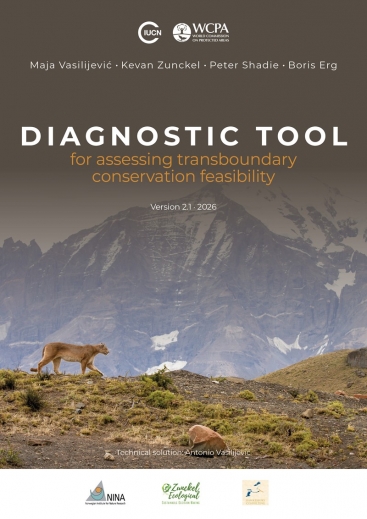
The new version of the Diagnostic Tool for assessing transboundary conservation feasibility V. 2.1 is now available for use by the TBC planners.
The Diagnostic Tool is a globally applicable, practical resource designed to support informed decision-making in transboundary conservation. By providing a rapid, structured assessment of transboundary conservation feasibility, it helps the users navigate complex cross-border conditions, identify shared priorities and differences, and build stakeholder consensus. The Diagnostic Tool is suitable for use by government agencies, protected and conserved area managers, civil society organizations, researchers, community representatives, and all others involved in the planning, development, or strengthening of transboundary conservation initiatives.
The Diagnostic Tool is structured around the pillars of sustainability and may be applied by an individual, a group of relevant stakeholders in one country, or by a multi-stakeholder group from all of the countries involved in a TBC initiative. If resources allow, the latter is the best option as it facilitates broad stakeholder engagement and thus initiates the building of relationships so essential for effective transboundary collaboration and governance.
Users of the Tool are encouraged to provide feedback to allow for any revisions that may be necessary, and/or just to let the authors know how and where it has been applied and to what extent it contributed to their TBC planning processes.
The tool is available for downloading here: https://www.nina.no/english/About-NINA/Projects/ACT-#_
--------------------------
Is there a need and compelling ecological reason for transboundary conservation approach?
What are the opportunities that could enhance a transboundary conservation process and/or be generated by transboundary conservation?
Are there any risks that might hold back the process?
Are the stakeholders ready and willing to support and engage in a transboundary conservation initiative?
Which elements could potentially strengthen the already ongoing transboundary conservation process?
These are some of the main questions the Diagnostic tool for transboundary conservation planners responds to, aiming to support the decision-making process leading to the institutionalization of transboundary conservation. More specifically, the diagnostic tool:
1) Enables the planners and facilitators to assess and evaluate feasibility for efficient design and implementation of a transboundary conservation initiative process
2) Enables the improvement of implementation of ongoing transboundary conservation initiatives
3) Strengthens the capacity of stakeholders in the potential or ongoing initiative on issues that are critical for the establishment and implementation of a transboundary conservation initiative
4) Offers the possibility of interactive participatory approach at transboundary or national levels
5) Enables rapid self-assessment of the feasibility for transboundary conservation
The diagnostic tool, authored by Maja Vasilijević, in consultation with Boris Erg and IUCN WCPA Transboundary Conservation Specialist Group, was initially published in 2012 in IUCN’s publication Initiating effective transboundary conservation: A practitioner’s guideline based on the experience from the Dinaric Arc, supported by the Ministry for Foreign Affairs of Finland. It was also prepared as technically upgraded electronic version. In 2020, the authors, including Kevan Zunckel as the reviewer, developed Version 2.0, building it on the latest understanding of transboundary conservation, guidance on the transboundary conservation process and feedback from practice. Version 2.0 was supported by WWF and Swedish International Development Cooperation Agency (Sida).
There are different ways to implement the tool. It can be completed during participatory interactive workshop(s) or by self-assessment. Each way results with automatically generated report that provides consolidated guidance on the future process.
DO YOU WANT TO KNOW MORE? Read the Transboundary conservation : a systematic and integrated approach - Guidelines
Approximately one-third of all terrestrial high-biodiversity sites straddle national land borders, yet few man-made boundaries are fixed, and international boundaries often alter over time or disappear altogether. This publication makes the compelling case for transboundary conservation approaches and promotes an array of innovative methods based on contemporary principles. It has been developed primarily to provide transboundary conservation managers with advice on how to work more effectively and how to address the challenges that are specific to transboundary conservation.
Available here: https://portals.iucn.org/library/node/45173